 The Evening Universe
The Double-Slit Experiment Is Stranger Than You Were Told
Premieres
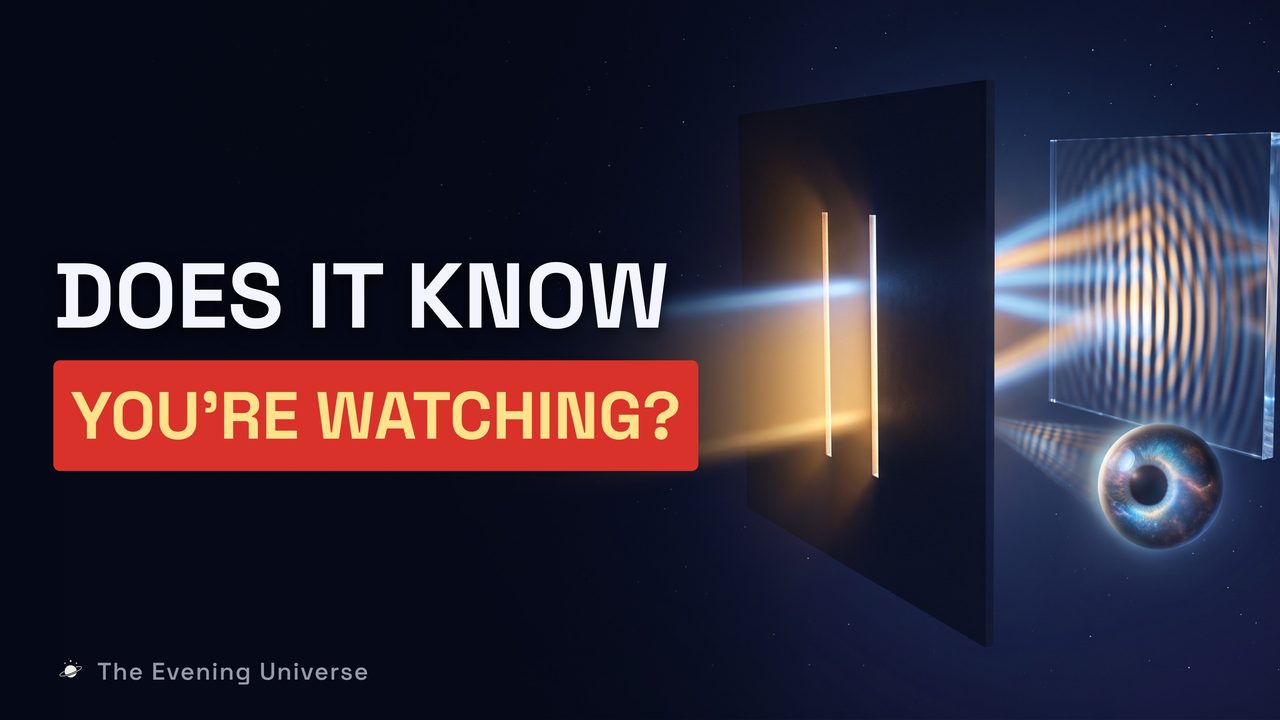
In the double-slit experiment, an electron behaves like a wave as long as nothing checks which slit it goes through, and like a particle as soon as its path can be known. This gave rise to the most misunderstood sentence in modern physics: observation changes reality. In this video we look at what the measurements actually show, and whether observing takes a conscious mind at all.
We'll cover Thomas Young's stripes, electrons arriving one at a time, the debate between Einstein and Bohr, a 1998 experiment in which the observer was a circuit, the roles of John von Neumann and Eugene Wigner, molecules of two thousand atoms, John Wheeler's delayed choice, and the quantum eraser, which is often said to rewrite the past. I'll show why it doesn't.
Of the three answers, the Copenhagen interpretation, the pilot wave and many worlds, which do you find the most convincing? Tell me in the comments!
Chapters
- The experiment that changes when we lookThe experiment that changes when we look
- Bullet or wave?Bullet or wave?
- What does the striped pattern tell us?What does the striped pattern tell us?
- Light that arrives one piece at a timeLight that arrives one piece at a time
- The most beautiful experimentThe most beautiful experiment
- If we look at which slit it goes throughIf we look at which slit it goes through
- Does observing take a person?Does observing take a person?
- How big can a wave be?How big can a wave be?
- The delayed choiceThe delayed choice
- The quantum eraserThe quantum eraser
- Does the future rewrite the past?Does the future rewrite the past?
- Three answersThree answers
- Evening ThoughtEvening Thought
- A question for youA question for you
Sources
A selection of the works and experiments this episode draws on:
- Young, Lectures (1807)
- Feynman, Lectures on Physics, vol. 3 (1965)
- Jönsson (1961)
- Merli, Missiroli and Pozzi (1974)
- Buks, Heiblum et al., Nature 391 (1998)
- Wheeler (1978)
- Jacques et al., Science 315 (2007)
- Scully and Drühl (1982)
- Kim et al., Physical Review Letters 84 (2000)
- Fein et al., Nature Physics (2019)
- Zeh (1970)
- Wigner (1961)